剛踏入新年,你可有特別的感覺和想法嗎?美國女詩人Kim Addonizio一首以新年為名的詩作”New Year’s Day”寫到正值四十歲的她渡過新年時的那份孤單、哀愁。詩人憶起少年時期認識的女同學們,曾經誰與誰一起快樂過,如今已各散東西,她現在也不在乎她們的存在了。詩人沒有許下甚麼新年願望,她只想活在當下,感受著當下的祝福,迎接新開始。
Author: Wendy Chan - English language & literature Tutor
Communion
It’s lunch hour, so
office ladies and gentlemen go to the café
take their seats and order their food
a grumpy lady sitting by the window venting her bitterness on the phone
two serious men talking about some insurance plans
a tired woman with a frowny and sorrowful face waiting alone at the corner
when hot food and soup arrive and fill their hunger
they light up, happy and alive
even more so with the delight of a cup of hot coffee or tea
broken as we may be
food feeds and heals us in a sacred way like the body of Christ.
Passion
My passion for arts isn’t a love at first sight
It is like two persons getting acquainted,
becoming friends,
getting along and knowing each other
more and more
deeper and deeper
then until one moment,
you are so attracted to that person
whom you find yourself suddenly fall in love with
and without whom your life is just missing a meaning to go on
and there is no turning back again.
Arts, to me, is like my lover
It does take me quite a long time to know and understand truly
Yet once fallen in love with
I love dearly, madly and unfailingly
and can never part with.
Heaven
Heaven
“What does heaven look like?”
I would think when I was a teen.
People would say heaven is something beautiful outside of this world
that Christians will go to once they die.
I was not lazy but neither was I very diligent.
If death was a passport to heaven, then it is not such a bad thing, isn’t it?
One day, at the university campus,
a female Christian leader quoted Matthew 11:12 “天國是努力進入的,努力的人就得著了”
That night, I made a dream, about my dream.
From then on, I worked like hell for it
like an unstoppable machine without fuel.
My dream was burning like a vibrant fire in the sprawling woods
I felt like being consumed by the violent fire in hell.
Bunyan put it right in Pilgrim’s Progress:
Only after being tried could we reach Heaven.
And now, I am in Heaven.
英詩賞析:Musée des Beaux Arts by W. H. Auden
詩人正在觀賞由文藝復興時期的大師繪畫關於耶穌誕生和殉道的畫作。字裏行間,不難發現詩人認同大師的看法:世間苦難是必然,人類是何其渺小,就算上帝要化成肉身拯救人類世界,祂自己也沒有例外,也要面對苦難,所以人類也該要明白自己作為人類的位置,苦難是不能避免。畫作當中呈現的是,就算耶穌將要來到人間,每個人對這個奇蹟的誕生抱著截然不同的態度;代表著智慧的老人家熱熾盼待耶穌的誕生,有些人仍在做著日常平凡生活的事情,代表著無知的小朋友也是在嬉戲玩樂,沒有為此特別高興雀躍。面對耶穌的受難死亡,他們更清楚這苦難其實在世界某角落必然發生,動物也仍在繼續他們被奴役的生活。
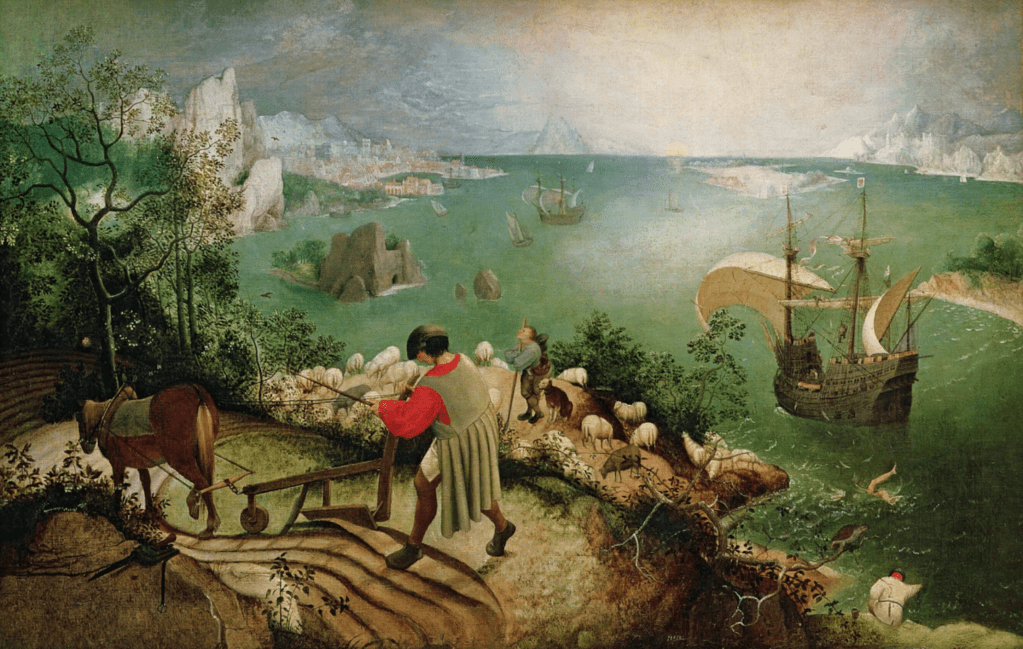
其中一幅的代表作是 Breughel的Icarus。Icarus在希臘神話象徵野心和不自量力,最終自討苦吃。人類和動物彷彿深明Icarus失敗受苦的原因,對他的苦難置若罔聞,繼續他們現在和明天的生活。
Musée des Beaux Arts by W. H. Auden
About suffering they were never wrong,
The Old Masters: how well they understood
Its human position; how it takes place
While someone else is eating or opening a window or just
walking dully along;
How, when the aged are reverently, passionately waiting
For the miraculous birth, there always must be
Children who did not specially want it to happen, skating
On a pond at the edge of the wood:
They never forgot
That even the dreadful martydom must run its course
Anyhow in a corner, some untidy spot
Where the dogs go on with their doggy
life and the torturer’s horse
Scratches its innocent behind on a tree.
In Breughel’s Icarus, for instance: how everything turns away
Quite leisurely from the disaster; the ploughman may
Have heard the splash, the forsaken cry,
But for him it was not an important failure; the sun shone
As it had to on the white legs disappearing into the green
Water; and the expensive delicate ship that must have seen
Something amazing, a boy falling out of the sky,
had somewhere to get to and sailed calmly on.
英詩賞析:Ode on a Grecian Urn by John Keats
詩人對著古希臘式的甕展開一場獨白及發問,望著圍繞甕上雕刻的有關神或人,男或女,追逐或逃避的古老故事沉思。這個甕好像一位歷史學家,在寧靜和慢慢流逝的時間當中訴說著一個比詩歌更甜美華麗的故事。
詩人首先在甕上看見一位純潔完美的新娘靜候出嫁,笛聲悠揚,樹葉正茂,甕上的雕刻給此時此刻定格了,令詩人歌頌這對新人的青春永遠存在,笛聲還有未奏完的樂曲,樹木永遠茂盛,可是這對戀人永遠無法接吻,不過,新娘的純潔完美永遠存在,而新郎的愛情永恆不朽,這個不會逝去的春天、不休止的奏樂,快樂的愛情,令人享受著永遠年輕和溫暖的時光,超越世間容易令人過熱和失落的愛慾。
接著發生的是一位牧師領著一隻小母牛到祭壇上準備獻牲,城内及街上的人全部跟著走到城外,城裏突然變為寂靜凋零,這畫面令詩人感觸一代又一代的凡人過去,再沒有人去講和聽這個故事,唯有這個甕永遠長存,向人類述說著不老的故事。
甕代表著藝術品,它記錄了/固定了當下的時刻,即是永恆的真理,而美就是這真理。雖然藝術品的確不像凡人或時間那樣流動,就好像那個永遠沒有接上的吻,但是藝術品的可貴之處就是它有別於凡夫俗子,它本身就是永恆不變的體現,而美就在此。如甕一樣,這首詩歌也是藝術品,其美永垂不朽。
Ode on a Grecian Urn by John Keats
Thou still unravish’d bride of quietness,
Thou foster-child of silence and slow time,
Sylvan historian, who canst thus express
A flowery tale more sweetly than our rhyme:
What leaf-fring’d legend haunts about thy shape
Of deities or mortals, or of both,
In Tempe or the dales of Arcady?
What men or gods are these? What maidens loth?
What mad pursuit? What struggle to escape?
What pipes and timbrels? What wild ecstasy?
Heard melodies are sweet, but those unheard
Are sweeter; therefore, ye soft pipes, play on;
Not to the sensual ear, but, more endear’d,
Pipe to the spirit ditties of no tone:
Fair youth, beneath the trees, thou canst not leave
Thy song, nor ever can those trees be bare;
Bold Lover, never, never canst thou kiss,
Though winning near the goal yet, do not grieve;
She cannot fade, though thou hast not thy bliss,
For ever wilt thou love, and she be fair!
Ah, happy, happy boughs! that cannot shed
Your leaves, nor ever bid the Spring adieu;
And, happy melodist, unwearied,
For ever piping songs for ever new;
More happy love! more happy, happy love!
For ever warm and still to be enjoy’d,
For ever panting, and for ever young;
All breathing human passion far above,
That leaves a heart high-sorrowful and cloy’d,
A burning forehead, and a parching tongue.
Who are these coming to the sacrifice?
To what green altar, O mysterious priest,
Lead’st thou that heifer lowing at the skies,
And all her silken flanks with garlands drest?
What little town by river or sea shore,
Or mountain-built with peaceful citadel,
Is emptied of this folk, this pious morn?
And, little town, thy streets for evermore
Will silent be; and not a soul to tell
Why thou art desolate, can e’er return.
O Attic shape! Fair attitude! with brede
Of marble men and maidens overwrought,
With forest branches and the trodden weed;
Thou, silent form, dost tease us out of thought
As doth eternity: Cold Pastoral!
When old age shall this generation waste,
Thou shalt remain, in midst of other woe
Than ours, a friend to man, to whom thou say’st,
“Beauty is truth, truth beauty,—that is all
Ye know on earth, and all ye need to know.”
daydream
daydream
Yes, that Saturday afternoon
between 1pm and 3pm
the weather was cloudy and bleak
Just like today
when my favourite TV series was on
and I was lying on the sofa
watching in the dim light
what college life could be like at one of
the top universities in the US
I was looking out the window in my desolate flat
at the sun setting in the far West
daydreaming about overseas education
Yes, I could still feel how definitely good it had felt
英詩賞析:Perhaps the World Ends Here by Joy Harjo
在這首詩裏,詩人以廚房餐桌作為「延伸隱喻」(extended metaphor)貫穿整首詩,象徵著人生的種種階段及經歷,由出生、成長、少年人做夢、成年人追夢,到學習做人、面對戰爭和苦難,回憶往事,人生的悲喜交集,親人的出生及離世,甚至到最後的死亡。與此同時,詩人透過廚房餐桌這個隱喻代表著家庭/鄰舎/群體的關係,大家一起經歷/分享人生的點點滴滴,彼此的故事潤澤著彼此的生命。雖然笑中有淚,但卻仍能以感恩作為人生的總結。
開首詩人以直述句指出,世界誕生於廚房餐桌,因為人類始於飲食,不論如何;自創世以來,大地的禮物(意即食物)給帶到餐桌上,令生命得以延續,所以生命亦圍繞著餐桌發生:
我們在餐桌旁追趕母雞或狗隻離開餐桌;嬰孩在餐桌角落長牙及搔癢他們的膝蓋。這個圖畫喻意生命的誕生及長大。如此同時,成人於餐桌給予小朋友教導,指導他們如何成長及做人;在餐桌這個地方,我們建立塑造男人和女人。
我們坐在餐桌說閑話,憶起敵人和情人的鬼魅。
我們少年的夢想好像喝咖啡般,有點苦的味道;夢想嘲笑著我們嘗試實踐夢想的失敗和沮喪,直到我們再次振作起來。
這張餐桌如同為我們遮風擋雨的屋企,又是讓我們能夠享受溫暖陽光的傘子。
戰爭亦於這張餐桌開始和結束;當戰爭的可怕來臨時,餐桌給我們躲避隱藏的地方;亦是慶祝慘烈勝利的地方。
我們在這張餐桌為到小生命的到來而高興唱歌,亦為到父母的喪葬而悲傷;我們為著苦難和懊悔禱告,亦獻上感恩。
當我們笑著哭著吃下最後一口飯,世界可能就在餐桌這個地方結束。
Perhaps the World Ends Here by Joy Harjo
The world begins at a kitchen table. No matter what, we must eat to live.
The gifts of earth are brought and prepared, set on the table. So it has been since creation, and it will go on.
We chase chickens or dogs away from it. Babies teethe at the corners. They scrape their knees under it.
It is here that children are given instructions on what it means to be human. We make men at it, we make women.
At this table we gossip, recall enemies and the ghosts of lovers.
Our dreams drink coffee with us as they put their arms around our children. They laugh with us at our poor falling-down selves and as we put ourselves back together once again at the table.
This table has been a house in the rain, an umbrella in the sun.
Wars have begun and ended at this table. It is a place to hide in the shadow of terror. A place to celebrate the terrible victory.
We have given birth on this table, and have prepared our parents for burial here.
At this table we sing with joy, with sorrow. We pray of suffering and remorse. We give thanks.
Perhaps the world will end at the kitchen table, while we are laughing and crying, eating of the last sweet bite.
英詩賞析:The Wild Iris by Louise Glück
我很喜歡這首詩,因為它確切地表達我在中學時期和職場生涯的經歷和感受,那種叫人如同死亡的苦難,簡言之,即是活著卻不能說話的靈魂,是多麼可怕。經歷苦難後的生命得著重生和超升,我可以再次說話了,並且找到了屬於自己的聲音,整個人好像活水泉源一樣擁有無限的生命力。
整首詩作者是以花的第一身視角作為視點及作為隱喻,以花所經歷的季節性死亡/轉化/重生比喻人類在苦難中所經歷的死亡/轉化/重生。
作者說她在自身苦難的盡頭看見一扇門。這代表著在黑暗和苦難的盡頭,作者看見出路。
然後,作者說她記得並具體形容經歷死亡的感覺,就好像當你還有意識的時候被埋葬在泥土裡頭,這樣窒息的活著是多麼可怕。作者繼續在下一段落描繪死亡的狀態 — 一個不能說話的靈魂。
然後,一切過去了,作者所懼怕的情況(即是作為一個不能說話的靈魂)突然終止;僵硬的泥土鬆開了點,而作者看到鳥兒俯衝在灌木叢中。作者指出死亡的狀態突然結束,換來的是下一刻破土而出的幼苗,這代表著重生;而鳥兒亦象徵著自由的生命。作者告訴那些忘記了曾經從另一個世界回來的人,我相信作者是指那些曾經從死亡國度回來得著重生的人,她現在可以再次說話了,她找到了屬於自己的聲音。可見一個能夠說話的靈魂是一個活潑生命的明證。作者得著重生後的生命充滿澎湃的活力和巨大的生命力,她比喻為從她生命的中心出現一道偉大的水泉,深藍的影子映照在蔚藍的海水上。這幅圖畫象徵著歷經如同死亡似的苦難後得著重生的生命是如此偉大、壯闊和美麗。
The Wild Iris by Louise Glück
At the end of my suffering
there was a door.
Hear me out: that which you call death
I remember.
Overhead, noises, branches of the pine shifting.
Then nothing. The weak sun
flickered over the dry surface.
It is terrible to survive
as consciousness
buried in the dark earth.
Then it was over: that which you fear, being
a soul and unable
to speak, ending abruptly, the stiff earth
bending a little. And what I took to be
birds darting in low shrubs.
You who do not remember
passage from the other world
I tell you I could speak again: whatever
returns from oblivion returns
to find a voice:
from the center of my life came
a great fountain, deep blue
shadows on azure sea water.
As sweet (a variation of the poet Wendy Cope’s poem “As sweet”)
As sweet
Though we are not so much alike
It is your kind of foreign ideas that attract me
They feel so exotic and exciting
I like to live in the otherness that you show me
And now we smile at the strange expression
After nine years of marriage
Because it’s so true
And as sweet as when I met you
 English language & literature